Work with the fruit that arrives
A large, firm fruit and a small, soft fruit do not behave alike at a transfer point or work surface. Incoming inspection therefore considers size, firmness, damage and usable flesh, alongside the production specification. Sound ripe fruit should be distinguishable from fruit rejected for deterioration.
FAO describes papaya as a thin-skinned fruit with soft flesh and highlights careful handling and removal of peel and seeds to protect puree flavour. In the preparation area, those characteristics favour supported fruit handling and clear separation of the edible and discarded portions.
Give cutting and cavity cleaning a defined workspace
A manual preparation arrangement provides stable work surfaces for cutting and peeling, access to the opened seed cavity, and separate containers for usable flesh and discarded material. The order of operations is chosen to suit the fruit and handling method. Food-contact utensils and collection surfaces need an accessible cleaning location.
Workstations are positioned between the inspection outlet and the prepared-flesh collection point. Waste should leave without crossing the flesh route. Operator reach, knife handling, floor drainage and access around moving conveyors are resolved in the layout before the line is installed.
Present prepared flesh to the machine consistently
The pulper feed needs pieces that fit its receiving opening and can enter without bridging. The collection method, delivery height and feed interval are set around that inlet. Accumulating prepared flesh in a large open pile makes neither the supply rate nor the time before processing predictable.
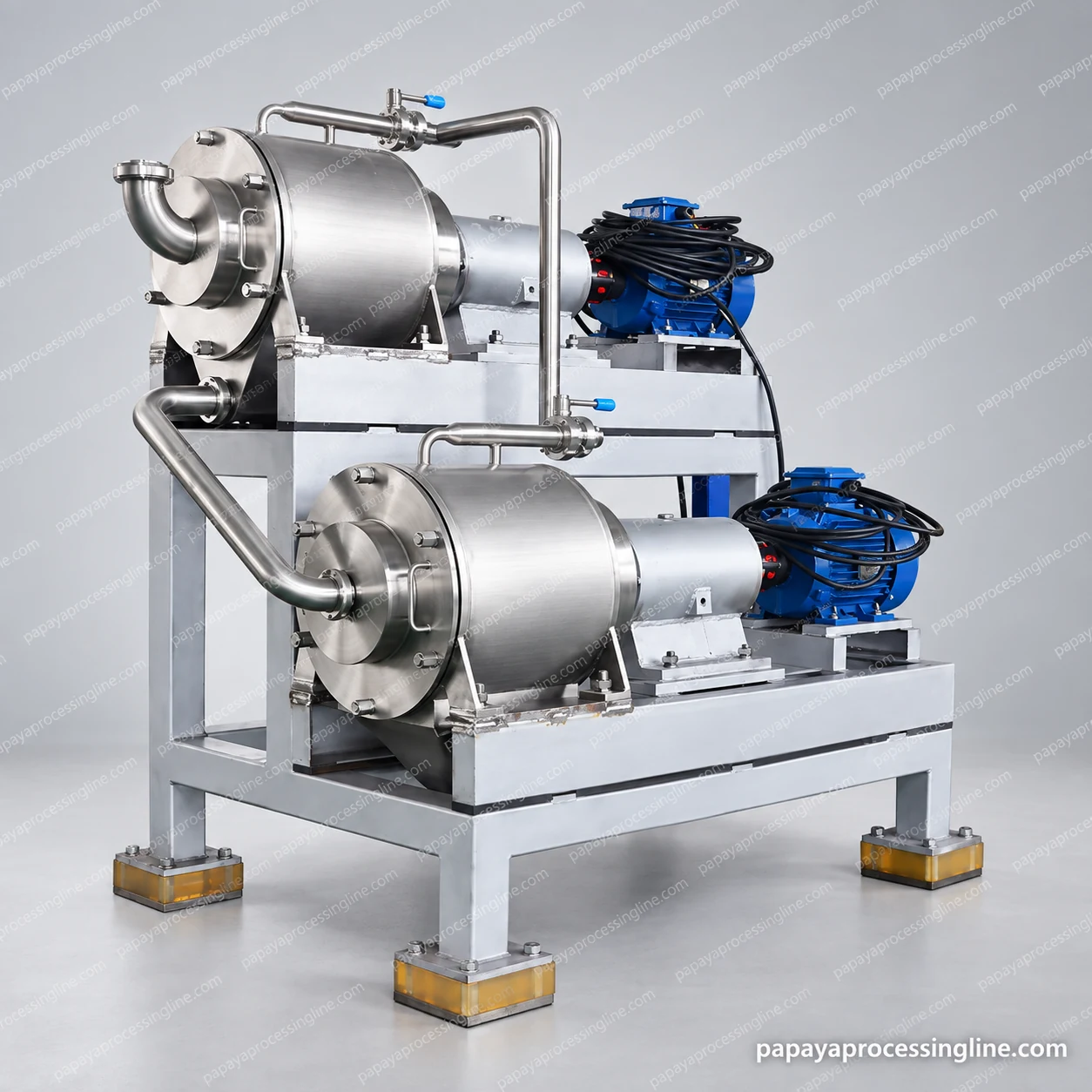
The dual-stage pulper-finisher performs pulp recovery and screening. Seed-cavity preparation remains an upstream task. The small seeds in papaya are not handled by adopting a mango stone-separation arrangement, and a finer finishing screen cannot be assumed to correct poor preparation.
Measure the preparation stage at its own boundaries
A preparation assessment records accepted whole fruit, usable flesh and the separated waste over the same period. It also observes whether flesh reaches the pulper steadily or in large batches. This distinguishes a handling bottleneck from a pulping limitation.
The production arrangement can combine manual work with existing mechanical handling. Its useful capacity is established from the complete sequence of fruit delivery, preparation, collection and cleaning. That result is then used to match the downstream machine and the intended shift pattern.