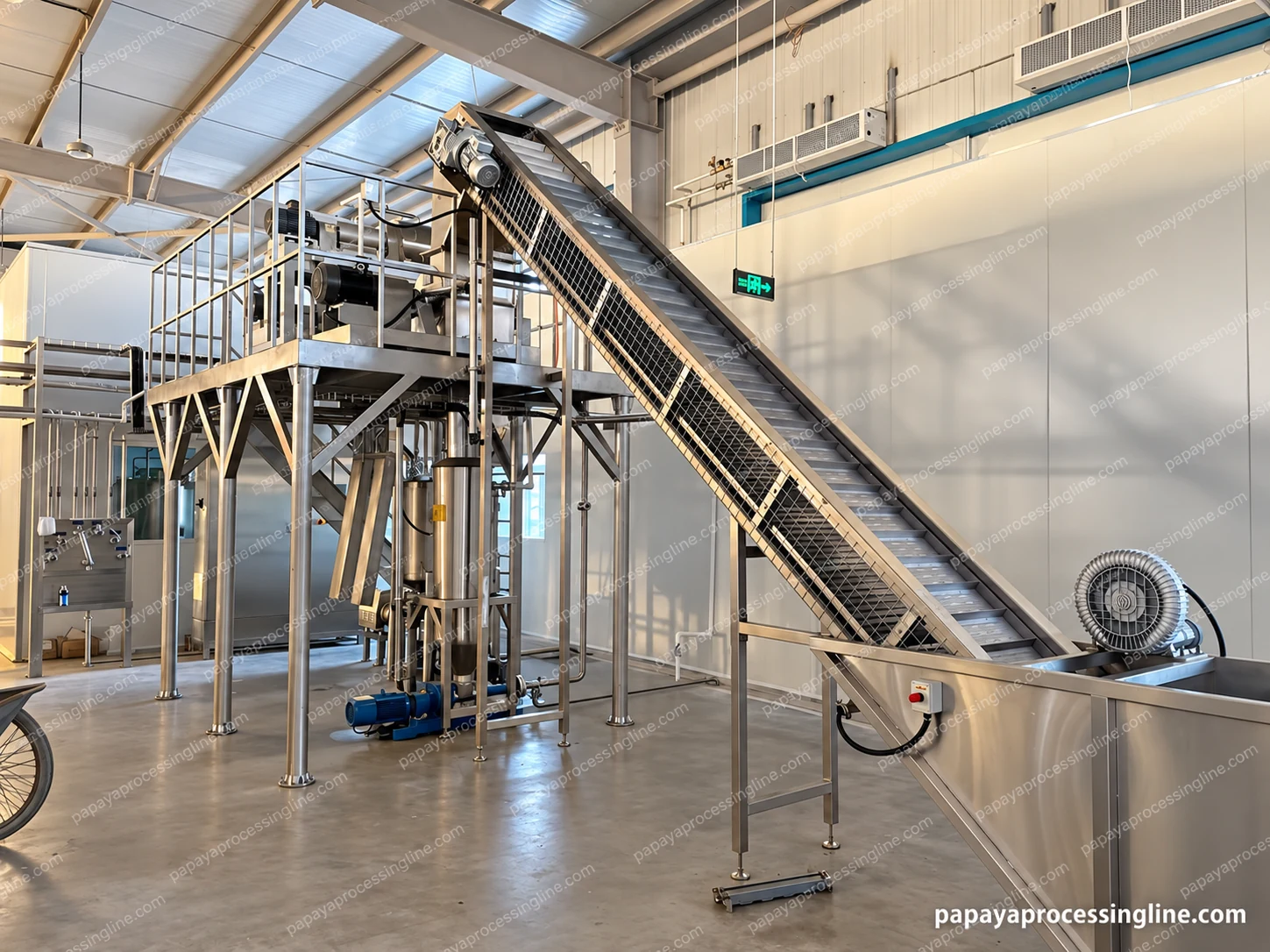
A gentle handover at both ends
The loading section receives fruit from the agreed receiving or washing stage. Side containment and belt supports need to accommodate elongated fruit as well as the smaller fruit in a batch. Avoid bridging at the inlet and accumulation at the discharge.
Match the discharge direction to the next machine or inspection belt. The height difference, transfer gap and receiving surface matter as much as the incline: a conveyor can meet a mass rate while still damaging soft fruit at the handover.
Dimensions that set the conveyor duty
| Input | What to specify | Design decision |
|---|---|---|
| Fruit envelope | Minimum and maximum length, diameter and mass | Belt width, side clearance and cleat spacing |
| Ripeness | Firmness range and allowed damage | Support surface and transfer arrangement |
| Vertical transfer | Inlet and outlet elevations with available floor length | Incline, frame height and access |
| Feed rate | Incoming fruit kg/h or t/h and batch surges | Usable belt loading and speed range |
| Wash interface | Wet or dry fruit and water carryover | Drainage and receiving layout |
Access underneath the belt
Leave access to the return run, underside, drainage area and guards. Pulp fragments and wash water should not collect where operators cannot see or reach them. Belt removal or release arrangements belong in the cleaning and maintenance review.
Confirm how operators isolate the drive before clearing a trapped fruit or opening a guard. A washdown procedure for the conveyor is separate from the closed-pipe CIP circuits downstream.
Specify the receiving and discharge interface
- Send a floor sketch showing the feed point, next machine and available aisle.
- Include photographs and dimensions of representative ripe papaya.
- State whether fruit arrives loose, from a wash tank or from another conveyor.
- Identify controls that should stop the upstream feed when downstream equipment pauses.
Questions in practice
Before connecting the equipment
Can an elevator rating be used as the puree output?
No. The elevator handles incoming fruit, including peel, seeds and fruit later rejected. Calculate prepared flesh and puree separately before selecting downstream equipment.