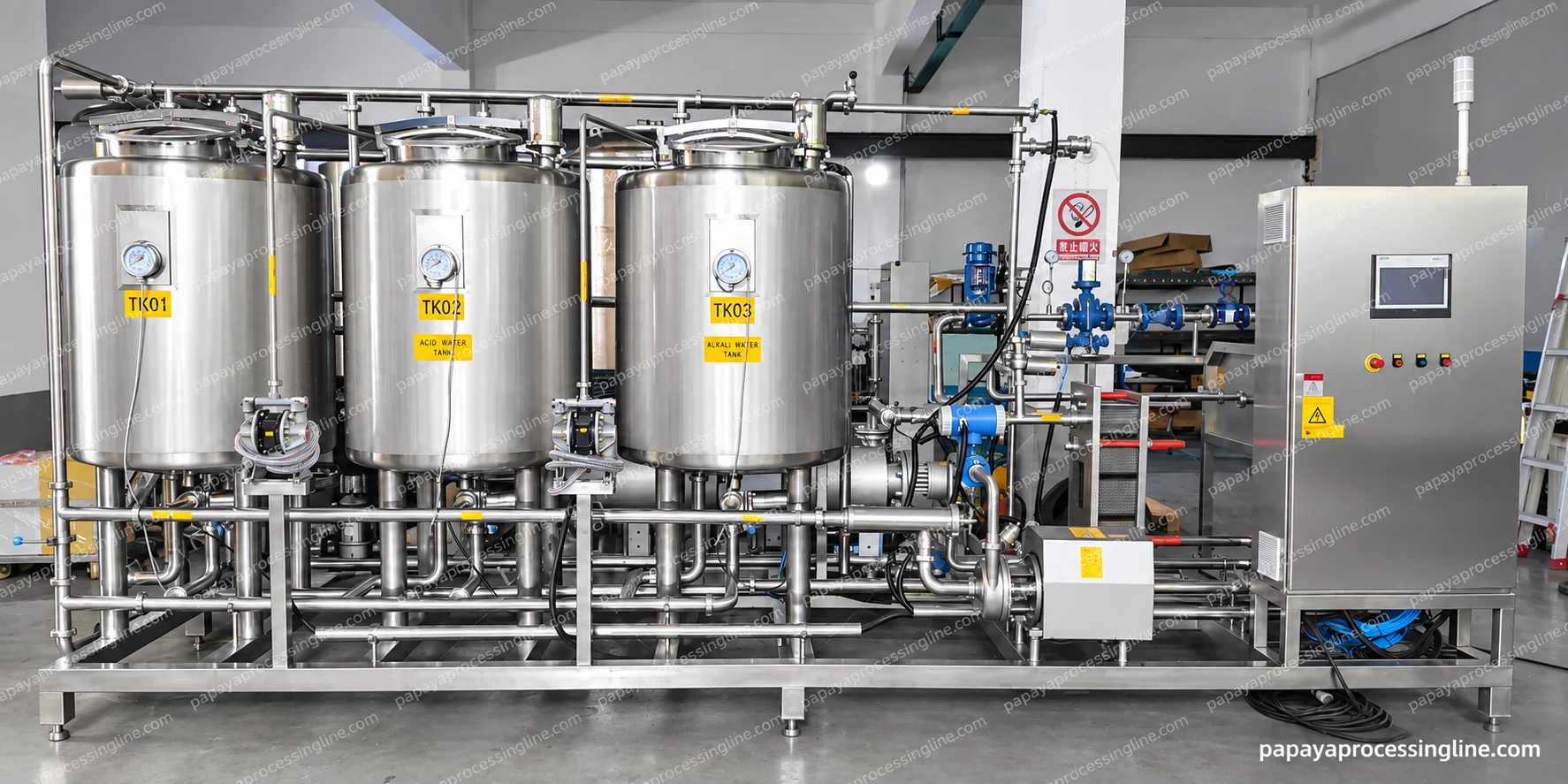
Draw the supply and return path first
Identify each circuit’s starting point, equipment, pipe route and return connection. Include branches, valves, instruments and low points so the cleaning design addresses the whole intended product-contact path.
The longest or most resistant route can set a different flow requirement from a nearby tank. Confirm the return conditions and the ability to drain the selected route before sizing the skid or combining circuits.
Select tank functions around the cleaning programme
Fresh water, alkaline solution, acid solution and recovered liquid are possible functions within the family. Assign them to the chosen tank arrangement and cleaning programme; four possible functions do not imply four vessels in the pictured three-tank skid.
Heating and control arrangements are configured for the cleaning duty. Specify solution compatibility, temperature limits and the cleaning requirements of each connected item before agreeing the sequence.
| Decision | Inputs to provide |
|---|---|
| Circuit flow | Pipework, component resistance and required cleaning conditions |
| Solution volume | Circuit hold-up, working levels and recovery plan |
| Heating | Available utility and selected solution temperature |
| Control and verification | Required measurements, records and acceptance checks |
| Drain and recovery | Disposal route and permitted reuse of returned solution |
Separate loose residue removal from circulation
Peel, seeds and coarse flesh should be kept out of downstream product routes during preparation. Remove accessible accumulated residues before the cleaning sequence specified for the equipment.
Pulper screens, open fruit conveyors and preparation work surfaces require direct access and inspection. Include dismantling where needed in their procedures; do not assume that connecting a CIP skid makes every surface in the line cleanable in place.
Define what a completed cleaning cycle means
Use a documented programme suited to the soil, equipment and cleaning agents. Define the conditions to record and the checks used to release equipment for production, including how a failed or interrupted cycle is handled.
Cleaning and sterilization have different objectives. Where an aseptic product route is required, establish its sterilization procedure and sterile-state controls as part of the treatment and filling system.
Questions in practice
Before connecting the equipment
Can one CIP recipe cover every part of the papaya line?
Define cleaning by equipment and soil. Closed puree circuits, removable pulper screens, open conveyors and preparation work surfaces have different access and cleaning needs. Confirm compatible procedures rather than applying one unqualified recipe to the whole line.