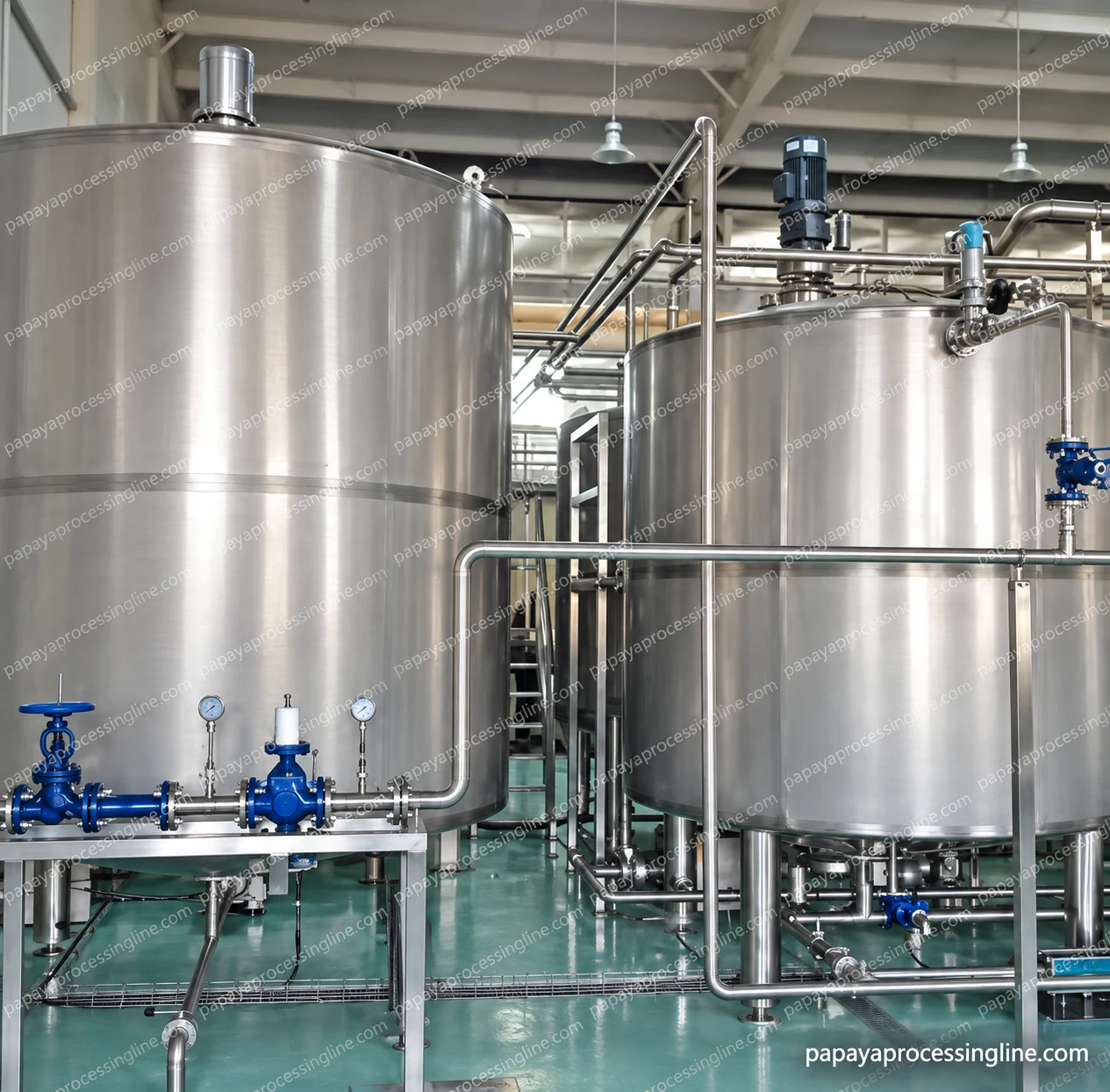
Set the interruption the tank must absorb
Start with the normal feed and withdrawal rates, then define the events the buffer should handle: a preparation pause, a pulper screen change or a brief packing interruption. A useful volume must cover the selected event without draining below the transfer system’s operating level or overflowing.
For an illustrative ten-minute feed interruption at a downstream draw of 600 L/h, 100 L of usable buffer would be consumed. This arithmetic is a sizing example, not a recommended tank volume; operating reserves and the product’s permitted holding conditions still need to be included.
Tank configuration follows the product
Consider whether agitation is needed to maintain consistency or distribute added ingredients. The drive, impeller, speed and mixing duty must suit the puree; a top-mounted motor alone does not establish the required result.
Access, drainability, level measurement and the cleanable connection to the next stage should be resolved together. Define any temperature control and maximum residence conditions in the product process specification.
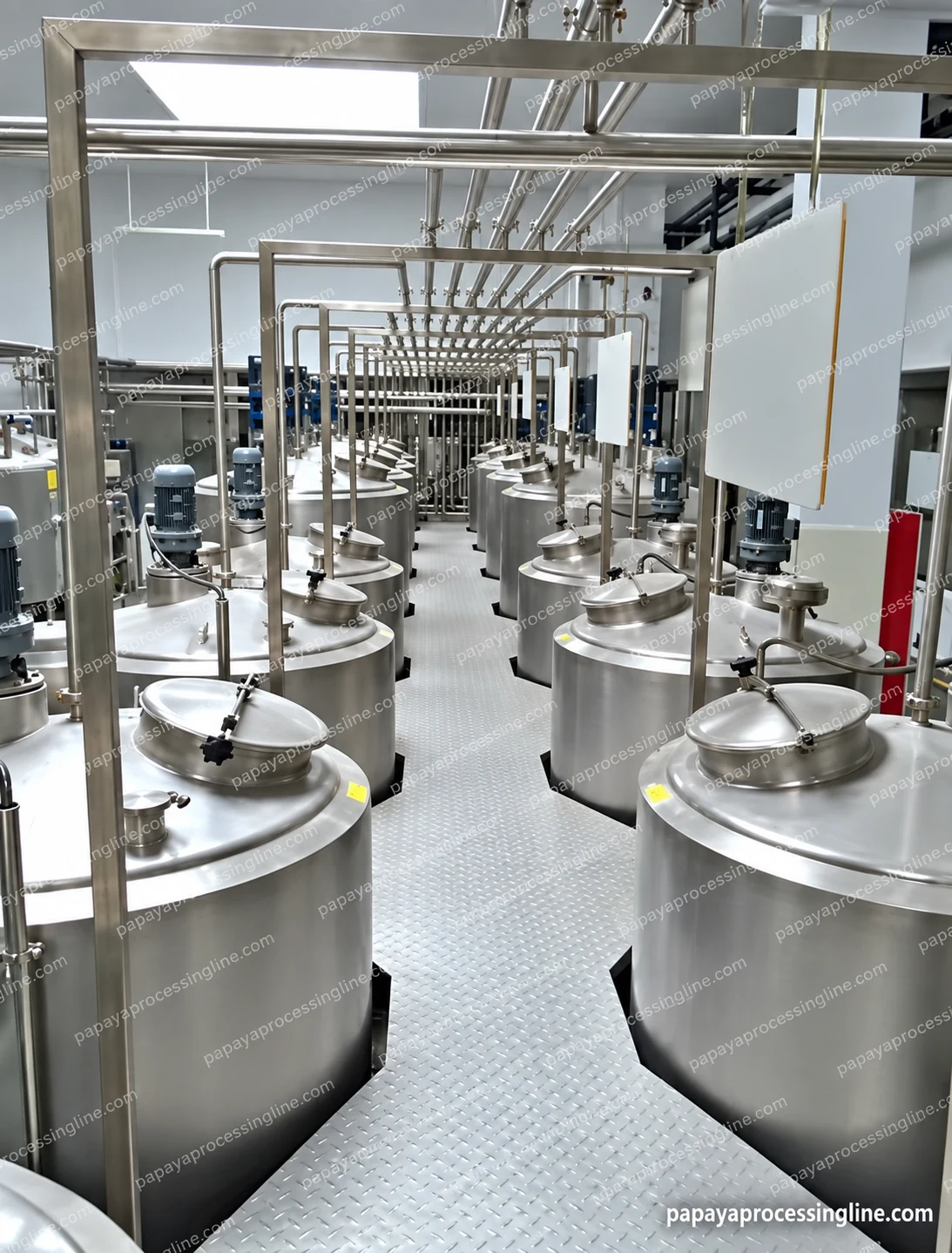
Select transfer equipment from a duty point
Specify the transfer pump as part of the assembly after these inputs are known. The vessel views do not identify a pump technology or a rated papaya transfer capacity.
| Required input | Selection consequence |
|---|---|
| Puree flow and operating range | Pump duty, control range and buffer behaviour |
| Viscosity at transfer temperature | Inlet conditions, losses and suitable pump design |
| Residual particle size and fibre | Product passage and risk of blockage |
| Pipe length, diameter and elevation | System pressure loss and layout |
| Downstream pressure requirement | Discharge duty and protection |
| Cleaning route and drain point | Connections, valves and cleaning access |
Control both starvation and overfilling
Coordinate level signals with the pulper feed, transfer system and downstream permissives. A low-level event and a downstream stop require defined responses, including the disposition of any product already in thermal treatment.
Document emptying, cleaning and restart states. A larger tank cannot correct an undersized downstream process and may increase holding time if the production balance is wrong.
Questions in practice
Before connecting the equipment
Is tank volume the same as hourly production capacity?
No. Volume describes storage space; hourly flow describes a rate. Use the working volume and the difference between inlet and outlet rates to calculate the interruption the tank can absorb.