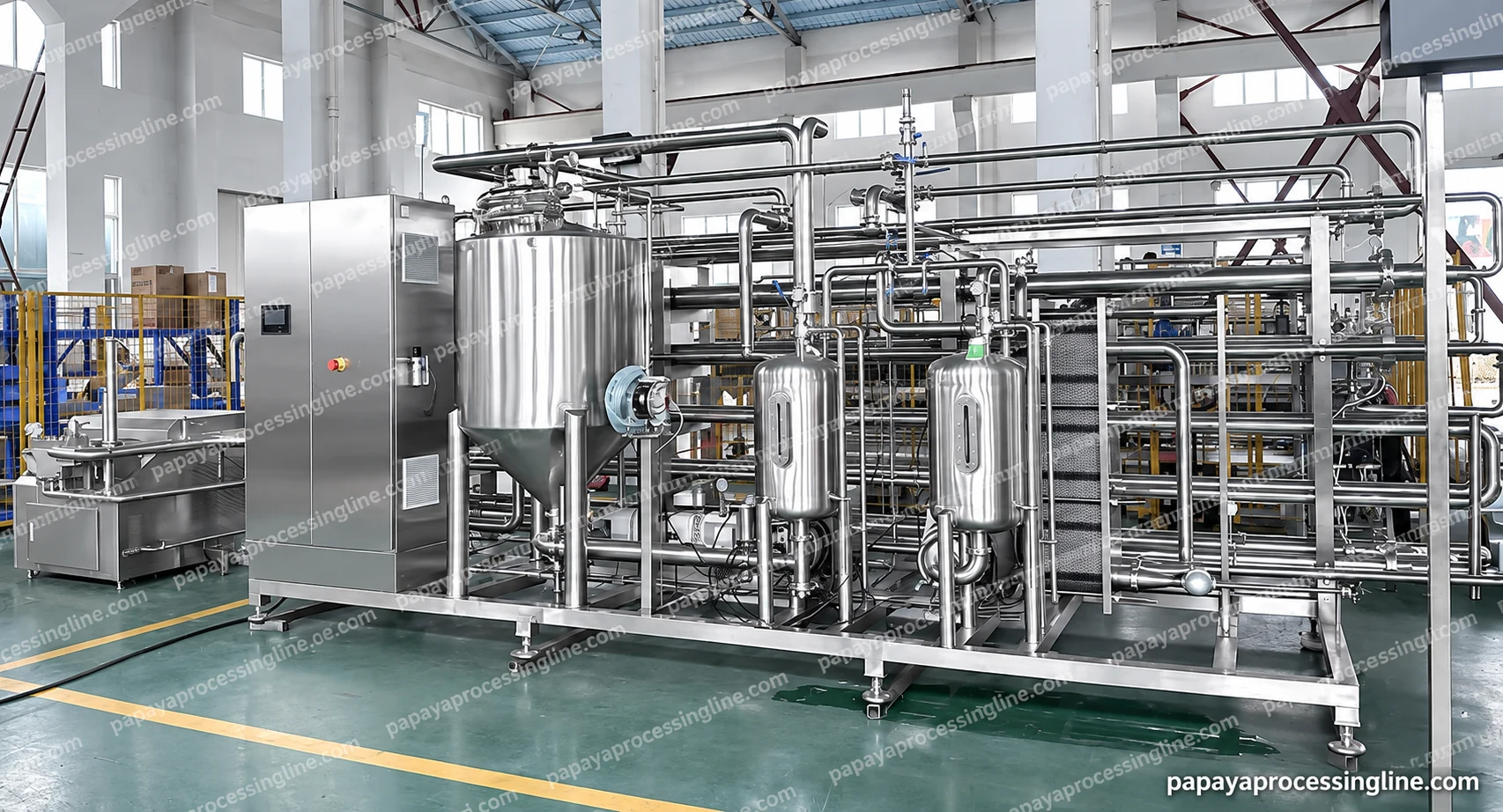
An integrated product and utility path
The transfer system delivers puree to the heating sections, the holding section provides the specified treatment interval, and cooling prepares the product for the next operation. Product resistance to flow and heat transfer both change with its composition and temperature.
Agree the heating medium, cooling-water conditions, available pressure and return arrangements before sizing the system. The pictured assembly illustrates the physical tube bank and supporting equipment; its dimensions do not establish a papaya duty point.
Configuration envelope and product process
The thermal family offers the configuration ranges below. They are equipment-selection references, not a paired temperature-and-time recipe for papaya. A particular build needs a specified duty, and the finished product needs an established treatment and packing process.
| Item | Family configuration reference | Confirm for this project |
|---|---|---|
| Temperature setting | 72–150 °C adjustable range | Validated product treatment and installed design limits |
| Holding interval | 15–120 s adjustable range | Effective holding at the specified flow and product |
| Heating medium | Hot water or steam arrangements | Utility conditions and heat duty |
| Cooling medium | Cooling water or chilled water arrangements | Supply temperature and outlet requirement |
| Material options | SUS304 / SUS316L | Product-contact specification and cleaning compatibility |
| Control arrangement | PLC-based control | Measurement, records, permissives and deviation handling |
Set the product conditions before selecting the cycle
Measure the product characteristics relevant to the process, including pH, soluble solids, viscosity and the largest retained particles. Identify whether the product is plain puree or a formulated blend and specify the intended storage and package.
The process must account for the material actually flowing through the system. Changing the screen, formulation or flow can change the treatment duty. Review those changes before treating a previously approved setting as applicable.
Define start-up, diversion and restart
- Set the conditions required before product can enter the accepted-product route.
- Define the response to low temperature, loss of flow, low buffer level and downstream interruption.
- Identify where diverted product goes and the decision for reuse or rejection.
- Record the measurements needed to review each run and the settings associated with it.
- Coordinate cleaning, sterilization where required and the downstream aseptic boundary.
The outlet condition belongs to the packaging plan
Aseptic filling requires the treatment outlet, sterile transfer route and filler to operate within a compatible process. Cooling temperature and permissible interruptions must be defined for that complete route.
For a different preservation or packaging method, specify its own handover conditions. Equipment settings alone do not establish a shelf life or a commercially sterile finished package.
Questions in practice
Before connecting the equipment
Which temperature should be used for papaya puree?
Set it through the product’s process design and validation, using its composition, pH, particles, flow and packaging route. The equipment’s adjustable range is not a safe operating recipe for every papaya product.