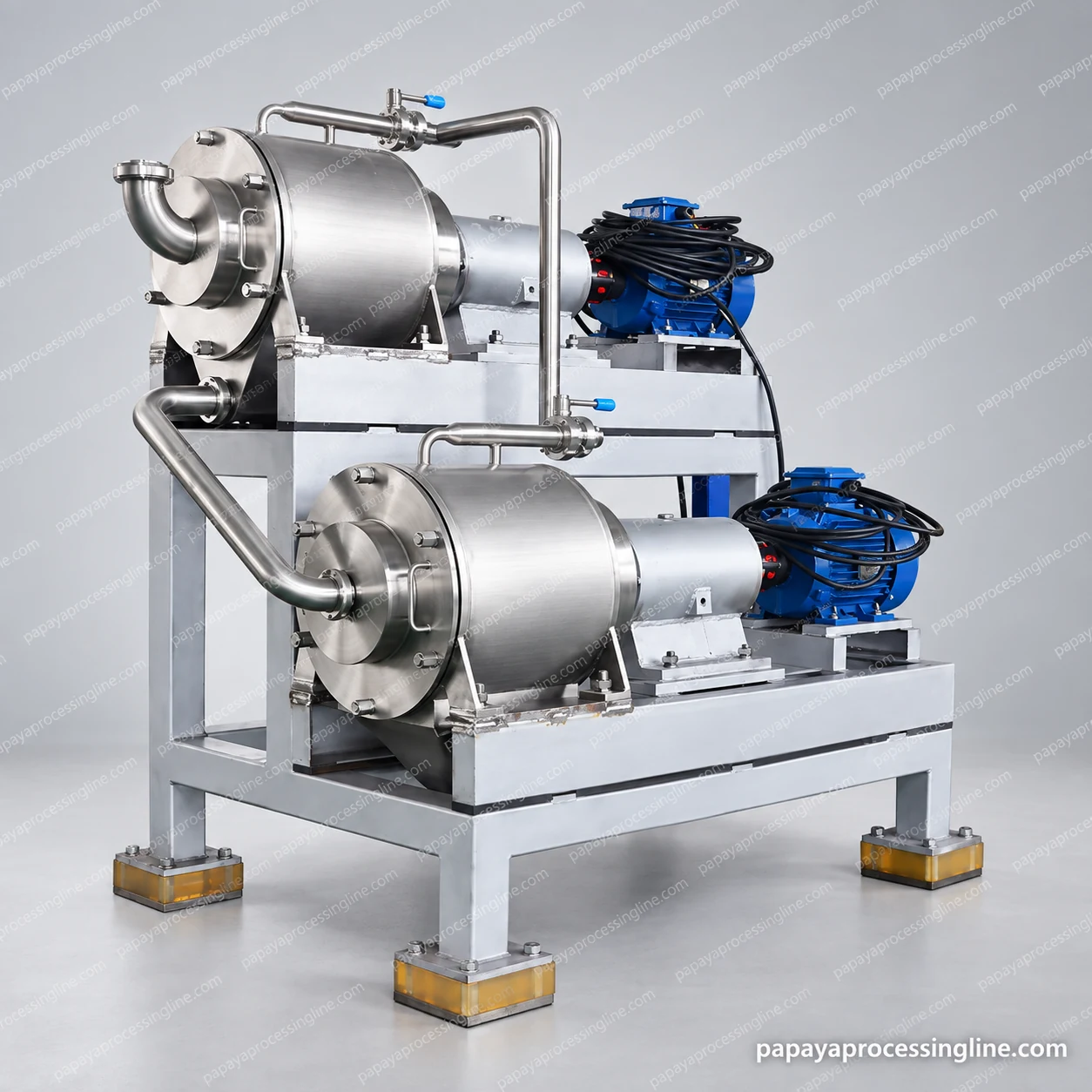
Pulping and finishing are separate duties in one assembly
The first stage breaks down prepared flesh and separates coarse residue. The second stage screens the intermediate pulp for the required finish. The interstage connection, two chamber bodies and individual drives are visible in the assembly.
Papaya seeds are distributed in a central cavity rather than arranged around a single stone. Remove the seed mass and peel during preparation, then inspect the flesh feed. Screens provide a refining step; they do not justify feeding whole seeded fruit or promising complete seed removal.
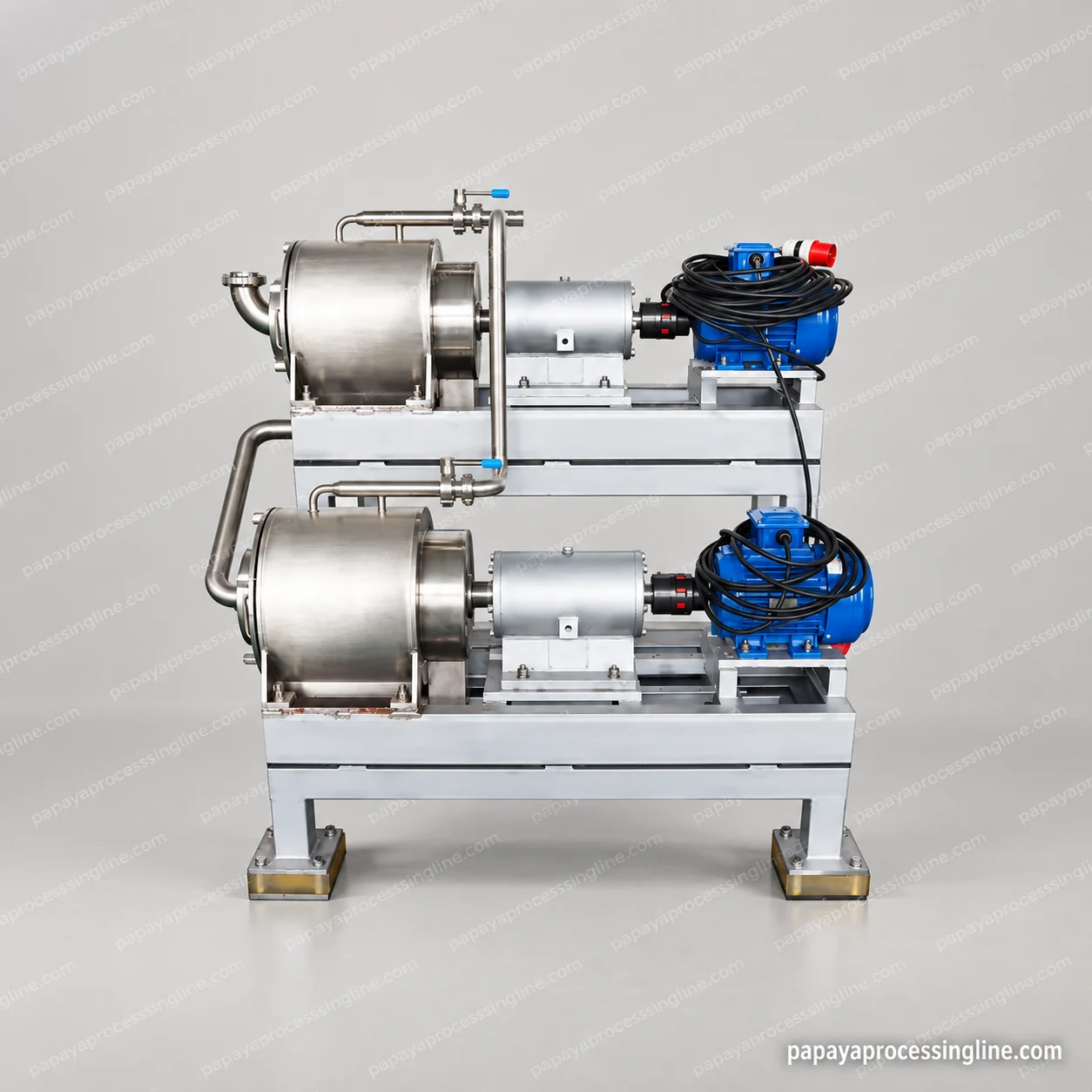
DJ family model reference
These catalogue ratings distinguish model sizes. They are not tested papaya output: the stated t/h basis does not identify fruit preparation, solids, ripeness or screen loading. Select against the actual prepared-flesh feed and verify both puree and reject streams in a trial. The photographed assembly is not assigned to a specific DJ size.
| Model | Catalogue capacity | Drive power | Overall dimensions, mm |
|---|---|---|---|
| DJ-3 | 1–3 t/h | 4.0 × 2 kW | 1550 × 1040 × 1500 |
| DJ-5 | 5 t/h | 7.5 × 2 kW | 1550 × 1040 × 1500 |
| DJ-10 | 10 t/h | 18.5 × 2 kW | 1900 × 1300 × 2000 |
| DJ-15 | 15 t/h | 30 + 18.5 kW | 2400 × 1400 × 2200 |
| DJ-25 | 25 t/h | 45 + 37 kW | 2400 × 1400 × 2200 |
Choose a screen from texture and residue measurements
Compare the finished puree against its intended ingredient use. Record visible fibre, coarse particles, consistency and the material leaving the reject outlet, using the same fruit condition and preparation method for each trial.
A smaller opening changes the separation duty and can restrict flow. It does not by itself establish a smoother acceptable product, higher recovery or a pumpable viscosity. Confirm the result after the selected finishing stage and at the intended process temperature.
- Record prepared-flesh input by mass and the trial duration.
- Weigh puree and rejected material separately using a consistent sampling period.
- Record the screen opening used in each stage and inspect the reject for lost flesh.
- Compare texture at the customer’s defined test condition before approving a screen combination.
Service space around the drives and screens
Leave room to open the chamber covers and withdraw the parts needed for cleaning and screen changes. The drive side also needs maintenance access without obstructing the pulp outlet or the residue collection route.
Confirm isolation, guarding and the cleaning sequence before operation. A circulating rinse is not a substitute for inspecting removable screens and areas where peel or fibre can lodge.
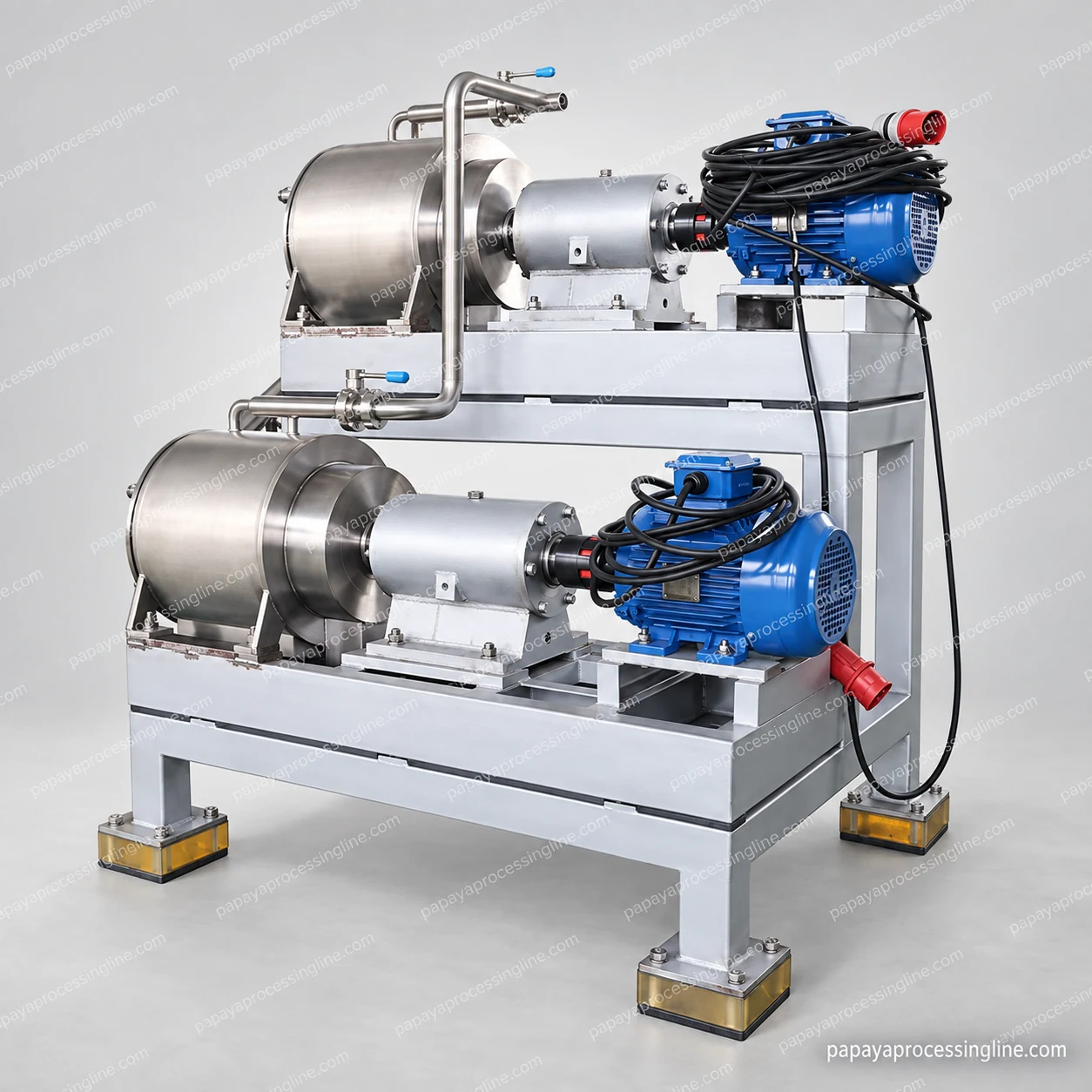
Connect preparation, rejects and puree transfer
Feed the machine steadily from the flesh-preparation stage. Provide separate collection for residue and a controlled route from the finished-puree outlet to the buffer or transfer system. A stoppage downstream should not leave puree accumulating at the outlet.
For selection, supply the fruit variety, ripeness range, prepared-flesh mass rate, desired texture and downstream treatment or packing route. Include the available floor space and the proposed method of collecting rejects.
See the working assembly
Two stages.
Three useful views.
Questions in practice
Before connecting the equipment
Are the pulper and finisher two separately listed machines?
This product is the photographed two-stage assembly. Its first and second chambers perform successive duties; selecting it does not require treating the second view or second chamber as another machine.
Does a DJ-5 rating mean 5 t/h of finished papaya puree?
No. It is a family catalogue capacity without a documented papaya test condition. Prepared-flesh feed, screen loading and rejected material must be measured before an output commitment is made.