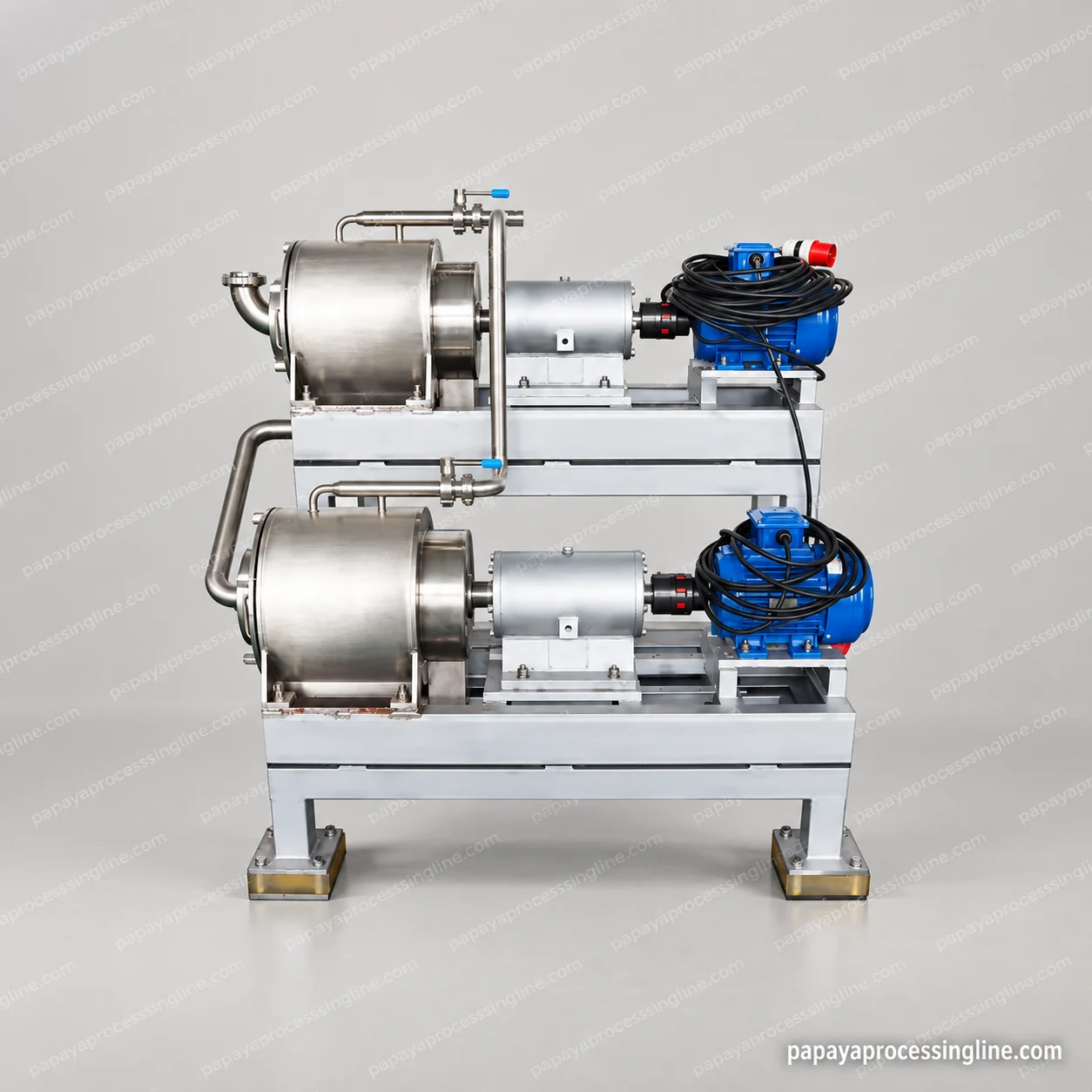
Use the stages for recovery and refinement
The first processing chamber works prepared flesh against its screen, recovering pulp and discharging separated material. The interstage connection feeds the second chamber, where further screening develops the required refined product. Each stage has its own drive, but the product passes through one combined machine.
The result depends on the prepared flesh, feed behaviour, screen condition and selected arrangement. Cleaning and reassembly also matter: a damaged or incorrectly fitted screen cannot be compensated for by adjusting the production target.
Compare texture and recovery together
A finer opening changes what can pass through the screen, but it is not a complete particle-size specification for the finished puree. Soft material can deform during processing, and the resulting product still needs to be assessed. Appearance, coarse particles and consistency are considered alongside the amount and composition of residue.
Trial samples should represent the same fruit lot and preparation method. Record the material fed, product collected and separated residue over the same interval. This gives a meaningful basis for comparing screen arrangements without assuming that a smoother sample always represents a better overall result.
Give a consistency measurement its conditions
Experimental research on papaya puree reported shear-dependent flow with yield stress under the tested conditions. Temperature and formulation affected its measured rheological behaviour. For equipment selection, a viscosity value therefore needs the sample temperature, composition and measurement method alongside it.
A pour observation is useful for comparing samples in production, but it does not replace the information needed to select a pump or calculate a thermal duty. Keep the sample handling method consistent and distinguish the freshly refined puree from a heated, cooled or blended product.
Carry the selected texture into the next stage
The chosen puree becomes the feed specification for the buffer pump, product piping and thermal section. Residual particles, consistency and temperature are relevant at those inlets, not only at the finishing outlet. If blending changes the product later, the downstream equipment is selected for the blend.
The final screening arrangement should balance the intended product character, recovery and steady feeding. It is then recorded with the trial conditions so that the same configuration can be identified during production and maintenance.