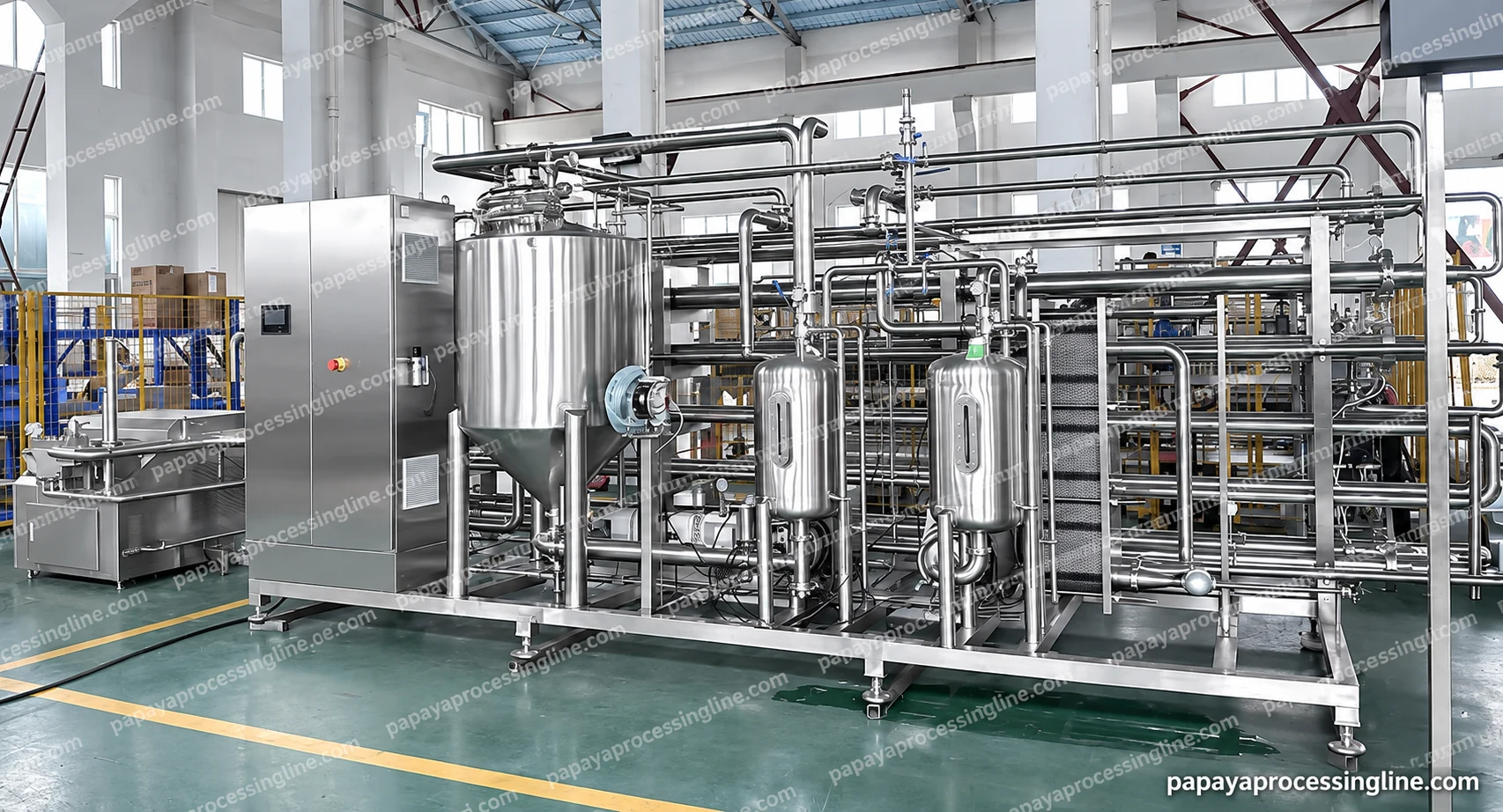
Give the thermal discussion a product basis
Describe the formulation, acidity information, particle condition, incoming temperature and intended outlet. These facts matter to equipment selection and the product-specific process design.
Whole-fruit intake is not the thermal feed duty. Establish the recovered-puree flow and operating schedule so the product pump and heating circuit are selected on the correct basis.
Review heating, holding and cooling as one route
The product moves through connected feed, heat-exchange, holding and cooling sections. Product flow and thermal duty influence each other, so a change in one requires review of the complete operating basis.
Controls should define startup, interruption and out-of-condition product routing. Discuss the requirements for instrument records and process verification with the selected preservation and packaging route.
| Selection point | Information to confirm |
|---|---|
| Product data | Formulation, acidity, texture and incoming temperature |
| Feed | Required puree flow and permitted variation |
| Outlet | Filling condition and packaging connection |
| Utilities | Available heating and cooling services |
Distinguish equipment description from process validation
A tubular assembly photograph establishes the equipment arrangement, not a universal time-and-temperature schedule for papaya. The process must be defined and verified for the actual formulation and intended handling conditions.
Provide the product specification and package with your enquiry. Where an existing treatment unit remains in service, include its operating boundaries and controls so the new equipment can be connected coherently.
Questions in practice
Before connecting the equipment
Is there one thermal setting for all papaya puree?
The product, formulation, flow and preservation route determine the process. A general equipment page cannot establish a universal validated setting.