Give the treatment package a defined feed
The starting product should have an agreed texture, temperature and flow behaviour. Coarse pulp may need refinement before it reaches the product pump and tubular circuit; an acceptable purchased puree can enter at the buffer stage.
Set the required product handover rate independently from whole-fruit reception. The thermal circuit should receive a controlled supply, with a defined response to upstream pauses and out-of-condition product.
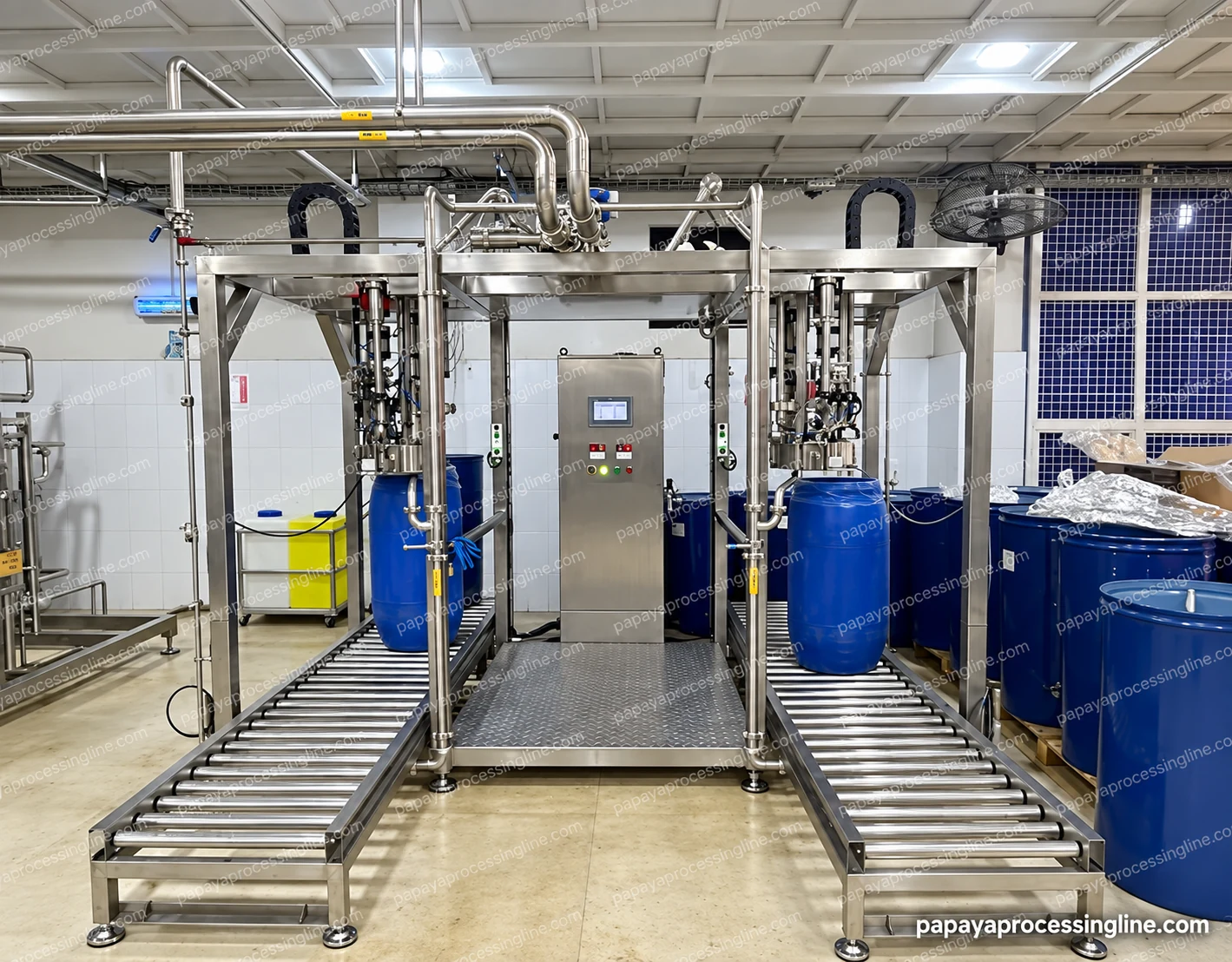
Treat the thermal unit and filler as one connected route
The tubular package combines product feed, heating, holding and cooling duties. Filling should resume only under the conditions defined by the agreed process and controls, rather than simply because a pump is running.
Aseptic operation depends on the complete product route, equipment condition and package connection. The equipment description is not a universal papaya sterilization recipe or a shelf-life guarantee.
| Selection point | Information to confirm |
|---|---|
| Product | Formulation, acidity information, texture and temperature |
| Duty | Required refined-puree flow and operating schedule |
| Package | Bag supplier, fitment and selected fill quantity |
| Controls | Startup, interruption and recovery conditions |
Define cleaning and sterile-state boundaries
Closed product circuits, the filler connection and open preparation equipment have different cleaning arrangements. Establish where CIP connections end and where direct access or dismantling remains necessary.
Provide the package specification and intended product handling conditions with your enquiry. A coordinated scope review should cover utilities, instrumentation, product routing and the requirements for process verification.
Questions in practice
Before connecting the equipment
Can the filler alone make the product aseptic?
The product treatment, connected sterile-state controls and compatible packaging sequence must work together. A filling head by itself does not establish the condition of the whole process.